NASA’s Space Plants Can Teach Us About MCS, Clean Air, and the Three Houseplants That Actually Work
Most people don’t realize it, but we’re basically living inside chemical boxes. Drywall, paints, adhesives, plastics, perfumes, detergents, solvents, aerosolized cleaners, synthetic fabrics—everyday materials that quietly release volatile organic compounds into the air we breathe. This matters for everyone, but for people with Multiple Chemical Sensitivity (MCS), it can turn an ordinary apartment into a difficult situation. A small whiff of detergent, a candle someone lit two rooms away, or even the “new electronics smell” drifting off a charger can send their bodies into full alarm: dizziness, headaches, breathing tightness, brain fog, etc…
Meanwhile, orbiting 220 miles above our heads, NASA is doing an experiment that unexpectedly may help folks with MCS. Their Plant Habitat-03 (PH-03) experiment is quietly exploring how plants adapt when they’re forced to grow inside a sealed metal habitat on the International Space Station. It’s essentially the ultimate test of clean air: a closed life-support system where every molecule is counted, filtered, and recycled, and where a plant must survive without the natural cues of soil, gravity, wind, and sunlight. NASA grows these plants seed-to-seed in space, sending the harvested seeds back to Earth so scientists can compare how space-born plants differ from their Earth-grown relatives. They look at gene expression, stress markers, and even epigenetic changes—whether spaceflight rewrites the plant’s biological “settings” to help it adapt.
It turns out that when you force a living thing to survive inside a sealed environment, the environment shapes the biology. Plants adjust epigenetically. Their DNA methylation patterns shift. Their stress-response genes activate differently. And many of those changes persist into the next generation. NASA treats this as essential data for future Mars and Moon habitats. But for us down here—especially those with MCS—it’s a metaphor, a warning, and a design lesson all in one. I mean,…. If plants need multiple generations of adaptation to survive inside a closed habitat, what does that say about humans trying to survive inside a sealed home full of synthetic chemistry that didn’t exist 80 years ago? Humans don’t get generational rewiring inside their own lifetime. Our nervous system has to adapt immediately, and sometimes it adapts in ways that feel like oversensitivity, hypervigilance, or inflammation. MCS is complex and multifactorial—part neurological, part immunological, part stress physiology, part genetics. But one thing is certain: clean air helps. You can feel it in your lungs, in your mood, in your clarity.
And here’s where NASA offers a surprisingly earthy granola solution. Inside the Advanced Plant Habitat—this highly engineered metal box floating in microgravity—the plants aren’t just growing for research. They’re stabilizing the habitat’s air. They absorb carbon dioxide, release oxygen, and take in volatile compounds. NASA learned decades ago that certain plants are extraordinarily good at pulling toxins out of sealed air. The science is mixed out in the blogosphere, but NASA’s controlled studies are not Instagram myths—they’re real data collected from real sealed systems.
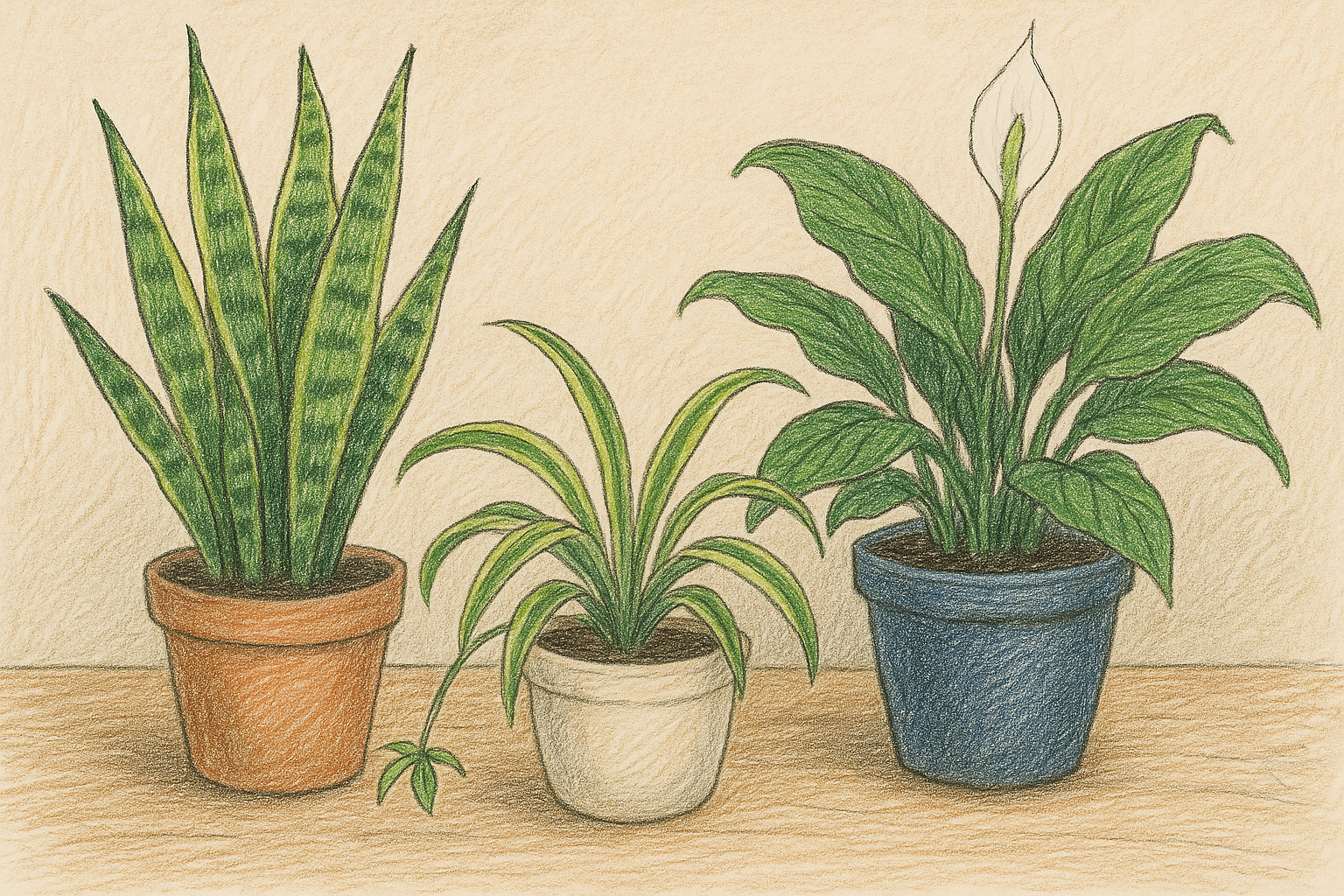
Three plants consistently stand out, especially for creating cleaner indoor air in tight environments. The first is the snake plant, the tough survivor of the plant kingdom, famous for absorbing chemicals like benzene, formaldehyde, and xylene, and for releasing oxygen at night—a rare trait that makes it perfect for bedrooms. The second is the peace lily, a glossy-leafed powerhouse that pulls trichloroethylene, benzene, and formaldehyde from the air while stabilizing humidity in a way that helps sensitive lungs. And the third is the spider plant, the easiest plant in the world to keep alive. It thrives on neglect, multiplies rapidly, and helps remove formaldehyde and carbon monoxide while tolerating almost any light conditions. These three plants are not magic, and they are not a cure. But in combination with good ventilation and low-VOC materials, they noticeably reduce the “chemical load” that sensitive brains and bodies have to process every day.
People with MCS often describe walking into a truly clean-air home and feeling their nervous system settle—breathing deepens, thinking clears, and the body stops bracing. NASA engineers understand this sensation because they design habitats as life-support systems rather than passive structures. Clean air isn’t optional in a spacecraft; it’s the whole mission. And as Earth buildings become more airtight for energy efficiency, we’re inching closer to the same reality. For chemically sensitive people, a home has to function more like a life-support module: minimal off-gassing materials, active filtration, good airflow, and a carefully designed mini-ecosystem where plants aren’t decor, but active participants in keeping the air breathable.
NASA’s PH-03 experiment reminds us that life adapts to its environment, but only if the environment is compatible with life in the first place. Humans can’t epigenetically reshape their sensory systems the way plants can. So instead of expecting our bodies to tough out the chemical storm, we can redesign our environments. Cleaner materials. Simpler products. No synthetic fragrances. Carbon and HEPA filtration. Good ventilation. And, yes, an indoor forest of plants proven to help: snake plant, peace lily, and spider plant.
You start with just those three, and the air in a home feels noticeably different. It’s calmer. Softer. More breathable. NASA didn’t set out to solve MCS, but their research on life inside sealed habitats accidentally provides a blueprint for anyone trying to live with chemical sensitivity on Earth. Build intentionally. Choose materials like your health depended on it. Bring in plants that work. And remember that your nervous system is not your enemy—it’s the sensor that’s trying to tell you what the environment is doing. When the air is truly inert and clean, and natural, the body knows. It relaxes. And that’s the beginning of healing.
Works Cited (MLA)
NASA. “Epigenetic Adaptation to the Spaceflight Environment – Accumulated Genomic Change Induced by Generations in Space (Plant Habitat-03).” NASA Science, 22 May 2023.
NASA. “Research Flies to the Space Station on SpaceX CRS-28.” NASA, 30 May 2023.
NASA. “Station Science 101: Plant Research.” NASA, 24 July 2024.
Petersen, Carolyn Collins. “Can Plants Be Adapted to Thrive in Space?” Universe Today, 4 Nov. 2022.
“Growing Plants in Space.” Phys.org, 19 Oct. 2023.
Fares-Medina, S., et al. “Multiple Chemical Sensitivity Syndrome: First Symptoms and Evolution of the Clinical Picture.” International Journal of Environmental Research and Public Health, vol. 19, 2022.
Jacques, Louis. “Multiple Chemical Sensitivity: A Clinical Perspective.” Brain Sciences, vol. 14, 2024.
Lavric, C. E., et al. “Multiple Chemical Sensitivity: A Review of Its Pathophysiology.” Exploration of Asthma & Allergy, vol. 2, 2024.
Rossi, S., et al. “Multiple Chemical Sensitivity: Review of the State of the Art in Epidemiology.” Journal of Occupational and Environmental Medicine, vol. 60, 2018.
Genovese, Giovanni, et al. “Multiple Chemical Sensitivity: An Italian Prevalence Multicentric Survey.” Frontiers in Public Health, 2025.